
If there was ever a time to not listen to the critics, it is now. Michael debuted with a disappointing 33% on Rotten Tomatoes, with a common critique being that the film brushed over important aspects of Michael’s fabled life. One report claims that the film is “bland, lionizing, and lacks any insight—in short, it fails at basically every aspect of being a biopic.” (Dean, Rotten Tomatoes). Contrastingly, it is the audience who is showering the film with praise, and I have to agree. Michael is move-bustingly good and will leave you dancing in your seat, wanting to perform the moonwalk as you exit the theatre.
For those who are unaware: no, this is not a biopic of Michael Bublé, but of Michael Jackson. Michael recounts his early years from ages 10 to 30, from his days with the Jackson 5 through to the Jacksons, and how he finally broke free of his father’s iron fist and became a solo artist, claiming the title of the King of Pop. Told through a series of concert-like footage, Michael is a must-see for any fan, whether to relive the golden days or for those who were born too late to witness his talent. The film feels like a concert; it is electric and soulful, leaving you grinning from ear to ear as you sit front and centre to greatness. There are many highlight performances; my personal favourites were Billie Jean at Motown 25 and the recreation of the famous Thriller music video. It is truly as though Michael has been reborn.
As previously mentioned, a lot of the negative reviews surrounding the film zero in on the lack of acknowledgement of the allegations against the pop star, and to that I say that the comments are invalid. During the timeline of this film, the allegations had not yet been brought forward: the film commences in 1988, as Michael undertakes the BAD world tour, ending on a performance in London. The allegations were brought to life in the mid 1990s, therefore making most of the issues critics are having with the film moot, as they attempt to highlight the allegations once more, which in turn would make the film a gossip-piece. By focusing on “what the film misses out”, you overlook what director Antoine Fuqua was striving for: a depiction of the journey Michael took to freeing himself from his controlling tycoon father, Joseph Jackson, and to reemerge as a global megastar.
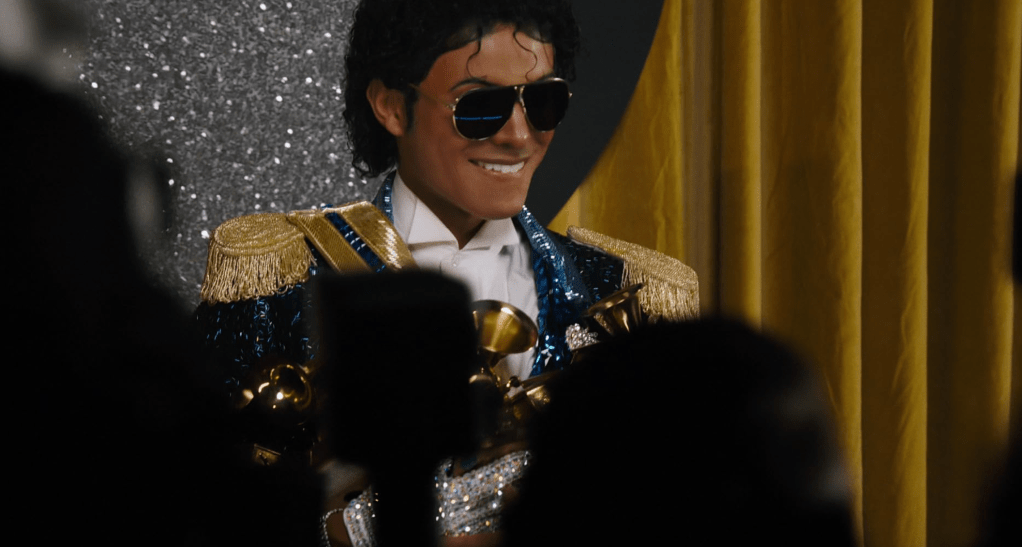
For me, the strongest aspect of the film is the cast and their acting. Playing Michael is Jaafar Jackson, the 29-year-old son of Jermaine Jackson, and Michael Jackson’s nephew. I was astounded to find out that before the biopic, Jaafar had never acted before, because he is sensational in the role of Michael; he embodies him in a way that has never been seen before. This is not nepotism, it was written in the stars. In an interview with GQ, Jaafar claimed that he didn’t want “to copy or mimic” his uncle; he wanted to “capture his essence”. I previously mentioned my love of the Motown 25 performance of Billie Jean.
Here, I think it represents Jaafar’s commitment to the role; he does an excellent job in recreating one of the most famous performances of all time. Jaafar perfected the role by researching his uncle’s mannerisms, specifically from when he didn’t know when he was being filmed. It is clear that a lot of love and care were put into capturing Michael’s presence. In the same interview, Jaafar remarked that when he first got the offer of Michael, he was hesitant: “If I go into it, I really want to commit”, which is clear when watching the film. You are hit by his polite and humble nature, which made him a fantastic fit to play up Michael’s vulnerability, but also, contrastingly, the power he commanded over the world, which allowed him to become one of the greats. Jaafar Jackson has a quiet kind of the Jackson’s legacy but has an undeniable echo of his uncle’s greatness, which I hope will take him far in the world…AKA get him that live-action Prince Naveen role, pronto!
The film starts out in the family living room of the Jackson household in Gary, Indiana, 1966. Joseph (Colman Domingo), who casts a malevolent shadow over the whole family, is putting his five sons through military-like rehearsals for the early days of Jackson 5. Joe is the coach and manager for the band, and rules tight-fistedly over the boys, as he believes their talent can lift the family out of their lower-class life. It is important to note that he is not afraid to use violence as a way to keep the boys in line, as we see early in the film, he reaches for his belt on young Michael, whom he seems to be the hardest on. There is no avoiding it; it is child abuse, and it’s clear to see that the boys are scared of him. What makes these scenes more impactful is that Juliano Valdi, who plays young Michael, is an extremely sweet kid and portrays well the vulnerability which stems from the harsh and isolating nature of Michael’s upbringing and carries through into his adulthood.
Through a sequence of performances, the film captures the rise of Jackson 5 with songs like “I’ll Be There” and “Who’s Lovin’ You”. Michael cuts to 1978, where we are introduced to adult Michael (Jaafar Jackson) as he meets with legendary producer Quincy Jones (Kendrick Samson) to record his first solo album, “Off the Wall”. Jaafar adopts Michael’s whispery, high sugary voice, but also validates his whimsical personality, as Michael is shown evolving their family estate, now in Encino, California, into a sort of zoo, filling it with a llama, a giraffe and the renowned chimp, Bubbles, who became an essential part of Michael’s image. Michael’s love of animals highlighted his loneliness, as those, albeit unusual, family pets were his only friends. One such scene that emphasises this point is when he returns home from the toy store with a game of Twister in clutch, asking his older brothers whether they want to play with him, in which their responses are no, with their minds focused on dating and more age-appropriate activities. After this rejection, the next scene cuts to Michael playing Twister with Bubbles, who represents the child-like wonderment that was taken from him at such an early age. At a law office, Michael bonds with John Branca (Miles Teller), an entertainment lawyer who repped other rising stars at the time, such as the Beach Boys and Neil Diamond. Upon claiming Branca to be a part of his own team, Michael instructs him to fire Joe as his manager, and to do it quickly, which Branca does via a short fax machine message. Upon the termination of contracts, Michael had hope that this would cut ties with his father, as he is no longer owned by him and gives him the creative freedom to conceive the idea of his next album, Thriller, which goes on to become one of the best-selling albums of all time, thus intensifying “Michael mania”.
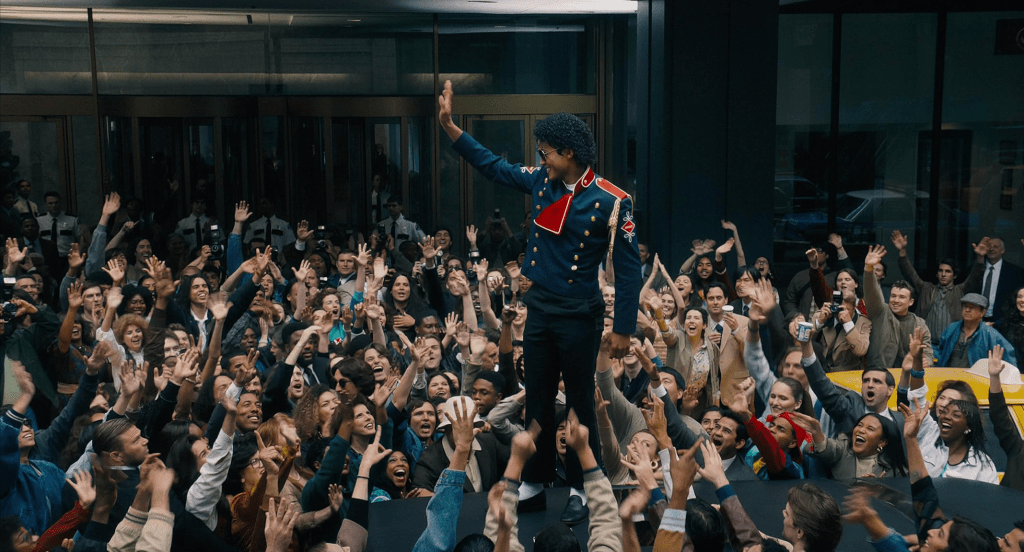
During the Thriller era, we clearly see Michael’s love for not only music but also dance, and how the two go hand in hand. Upon a late-night brainstorming session, Michael turns on the TV to a news report of rival gangs prevalent in the 80s, thus inspiring the hit, “Beat It”. Michael brings forward a sensitivity to the world, a message that was to bring the world together. During the “Beat It” scene, Michael goes to a club with opposing gang members, the Bloods (often associated with red) and the Crips (associated with blue) and draws up the choreography for “Beat It” that goes on to be used in the 18-minute-long music video that was directed by Martin Scorsese. This love of dance is synonymous with the Jackson image and would become his trademark. Yet even still, as Michael finally has control of his life (and image, with various cosmetic surgeries), the tyrannical presence of his father looms over him. After the success of Thriller, Joe wants to capitalise on this by doing a reunion tour with Jackson 5. Behind Michael’s back, Joe reaches an agreement with promoter Don King (Deon Cole) that if Michael would do a tour with his brothers, he would become the face of Pepsi. Thus, the infamous and horrifying Pepsi accident, where his hair and scalp were set alight, which changed the trajectory of Michael’s life forever.
The film ends with Michael on tour with his brothers for the Victory tour, with a mesmerising performance of “Human Nature”. This is where you truly feel the electricity of a Michael Jackson concert and are able to witness his true greatness as an artist and a performer. Thereafter, he blows off his father forever by publicly announcing that it was to be their last performance as a group, as Michael goes solo forever. After promptly leaving the stage, we are fast-forwarded to four years later to another onstage performance of “Bad”, and the move leaves us with the statement “His story continues…”. In other words, we are getting a sequel babyyyyy… It is unclear as to what to expect in the next instalment of the film, as it’s not often a biopic gets a sequel; however, we are most likely guaranteed hit performances of Smooth Criminal and Dirty Diana. I’m excited to see where they will take it, and whether they will address the allegations and the supposed “dark side”. Whatever happens, I’m sure we’re in for a groovy time, and if they’re looking for title suggestions, I have some they could use: “2 Michael 2 Jackson” or perhaps just “Jackson”, please don’t let it be “Michael 2”.


Leave a Reply